

Table of Contents
- The Visual and Spatial Impact of Oversized Landscape Art
- Art to Wall Ratio Rules: Getting the Proportion Right
- Large Wall Art Placement Guide: Hanging Height and Position
- Structural, Weight, and Installation Challenges
- Lighting, Colour Saturation, and Visual Perception
- Transport, Storage, and Resale Considerations
- Practical Steps: Assessing and Testing Your Space Before Buying
- Frequently Asked Questions
Last Updated: September 1, 2026
The Visual and Spatial Impact of Oversized Landscape Art
Hanging landscape art that's too large disrupts spatial harmony, affects how your eye moves through a room, and fundamentally changes the relationship between the artwork and everything around it. When landscape art exceeds proportions your room can handle, the focal point becomes overwhelming rather than anchoring. Research in environmental psychology shows that large-scale artworks evoke stronger emotional responses compared to smaller pieces, but there's a critical threshold: push too far, and that response shifts from engagement to discomfort.
How scale affects room focal points and spatial harmony
A well-scaled landscape piece anchors a room and organises visual hierarchy. An oversized piece colonises it. This happens because of visual weight. A large canvas with bold colours, high contrast, or dramatic brushwork carries tremendous visual weight. When disproportionate to the wall, the room loses spatial harmony. Furniture, architectural features, and other walls become secondary. If your landscape art takes up 80% of a wall, the remaining 20% becomes visual debris. Spatial harmony requires visual balance; when one element overwhelms, that harmony collapses.
Visual clutter versus drama: finding the balance
Drama is intentional, a large landscape piece that commands attention because it's meant to. Clutter is accidental, a large piece that dominates because nobody measured properly. Drama works when oversized art is the deliberate focal point of an intentionally designed space. Furniture is arranged to acknowledge it, the colour palette complements it, and lighting highlights it. Clutter happens when a large canvas is hung without considering its relationship to the rest of the room. The difference is intentionality and proportion. If you're choosing oversized landscape art, commit to designing the entire room around it.
Art to Wall Ratio Rules: Getting the Proportion Right
The relationship between artwork size and wall dimensions follows a consistent standard across interior design. Getting this proportion right prevents oversized landscape art from becoming a problem.
The 50-75% wall coverage standard
Interior designers use a simple rule: artwork should cover between 50% and 75% of the wall space it occupies. Below 50%, the artwork feels lost. Above 75%, the piece feels cramped. If you have a wall that's 3 metres wide and 2.4 metres tall (7.2 square metres), 50% coverage is approximately 3.6 square metres and 75% is about 5.4 square metres. Most landscape canvases fall comfortably within this range when chosen correctly. The challenge is that many pieces are sold in standard sizes that don't align with this principle. Measurement becomes essential.
Balancing canvas size with wall dimensions
Canvas size and wall dimensions must work together. A landscape format canvas (wider than tall) works differently on a wall than portrait or square formats. If your wall is wide and relatively short, 4 metres wide and 2 metres tall, a landscape canvas works naturally. If your wall is narrower or taller, a landscape canvas that's too wide will feel cramped and awkward. Measure your wall width, height, and distance from adjacent architectural features, doorways, and windows. A 2-metre-wide canvas might be perfect on a 4-metre wall but overwhelming on a 2.5-metre wall.
Large Wall Art Placement Guide: Hanging Height and Position
Where you hang a landscape canvas matters as much as how large it is.
Eye level and the 145cm rule
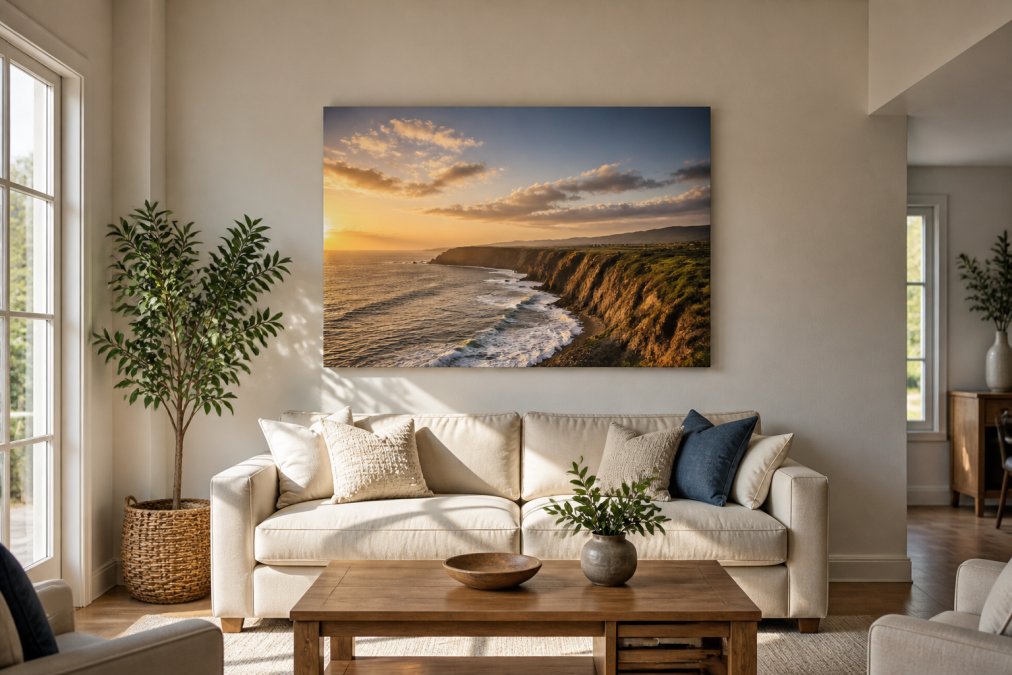
The standard guideline is straightforward: the centre of any wall art piece should sit at approximately 145 centimetres from the floor to align with average eye level. Mae Osz, Interior Design Consultant states that "the centre of any wall art piece should sit at approximately 145cm from the floor to align with average eye level in most rooms." This isn't arbitrary. Eye level is where your gaze naturally settles when you enter a space. For oversized landscape art, this rule becomes critical. When a large canvas is hung too high or too low, the scale problem compounds. Hanging at 145 centimetres helps an oversized piece feel anchored and purposeful.
Anchoring a space without overwhelming it
Anchoring a space means using art to organise visual hierarchy without dominating it. If you're hanging a large landscape canvas above a sofa, the canvas should relate proportionally to the sofa. The distance from the top of the sofa to the bottom of the canvas should be roughly 20-30 centimetres. For oversized pieces, consider positioning above substantial furniture, a large sectional, console table, or fireplace mantel with weight and presence. The key is ensuring the art and furniture create a unified composition.
Structural, Weight, and Installation Challenges
Large landscape canvases are a physical consideration. The structural demands of hanging oversized art are often underestimated.
Assessing wall capacity and mounting hardware
Before hanging any large canvas, know what your wall can support. Drywall alone cannot safely hold a heavy oversized canvas. Locate the studs in your wall and anchor mounting hardware directly to them. A typical stud is located every 40-60 centimetres. For a large landscape canvas, you'll need at least two mounting points, ideally three or four. Each should be anchored to a stud using heavy-duty wall anchors rated for the weight. Most large canvas art weighs between 2-5 kilograms. A canvas that falls can damage the artwork, your wall, furniture, and potentially injure someone. Use a stud finder and mounting hardware rated for your specific canvas weight.
Canvas tension and frame integrity in large formats
Canvas tension refers to how tightly the fabric is stretched across the frame. For large landscape pieces, this becomes critical. If the canvas isn't stretched tightly enough, it will sag over time. Large formats are more susceptible to environmental changes, temperature fluctuations and humidity. Frame integrity matters equally. A wooden frame supporting a large canvas experiences significant stress at corners and joints. Poor-quality frames can develop cracks or separations. When investing in a large landscape art piece, frame quality directly affects how long the canvas maintains its appearance and structural integrity.
Lighting, Colour Saturation, and Visual Perception
How light interacts with a large landscape canvas fundamentally changes how you perceive it.
How oversized art demands proper lighting design
A small landscape canvas works in almost any lighting condition. A large landscape canvas is unforgiving. It demands proper lighting, spotlights, track lighting, or wall-mounted fixtures positioned to illuminate the canvas directly. Without this, the piece relies on ambient room lighting, which is rarely sufficient. The angle of light matters too. Light hitting the canvas at 30-45 degrees from the surface illuminates it evenly without creating hotspots or shadows. If your room lacks adequate lighting infrastructure, you'll need to invest in it. A beautiful canvas in poor lighting becomes a disappointing purchase quickly.
Colour intensity and brushwork scale in large pieces
Colour saturation changes perception at scale. A landscape canvas with bold, saturated colours reads differently when oversized. The colours feel more intense, more aggressive. Warm, saturated colours feel even warmer and more present at large scale. Cool colours feel more recessive but still carry intensity. Neutral tones and muted colours are more forgiving at large scale. Before committing to a large landscape canvas, consider how the colours will feel in your specific room at full scale. A print that looks balanced online can feel overwhelming in person.
Transport, Storage, and Resale Considerations
The logistics of oversized landscape art extend beyond hanging.
Logistics of moving oversized canvas
Transporting a large landscape canvas requires protection during transit, wrapping, padding, and securing so it doesn't shift or get damaged. For framed canvases, professional moving services are often necessary. Unframed canvases are lighter but more vulnerable to damage. If ordering online from paints2prints, reputable suppliers use protective packaging and shipping methods designed for large, fragile items. Storage requires flat placement in a climate-controlled environment. Leaning canvases against walls can cause warping. Damp or temperature-variable spaces can affect the canvas and frame.
Investment value and market appeal
Large contemporary landscape canvases have a narrower market than smaller pieces. They're harder to place in most homes, limiting potential buyers. If you move to a smaller space, your large canvas might not fit. However, quality landscape art from established artists or high-quality suppliers does hold value. Buy from a supplier with a reputation for quality.
Practical Steps: Assessing and Testing Your Space Before Buying
The best way to avoid problems is to test before you buy.
Measuring and visualising art in your room
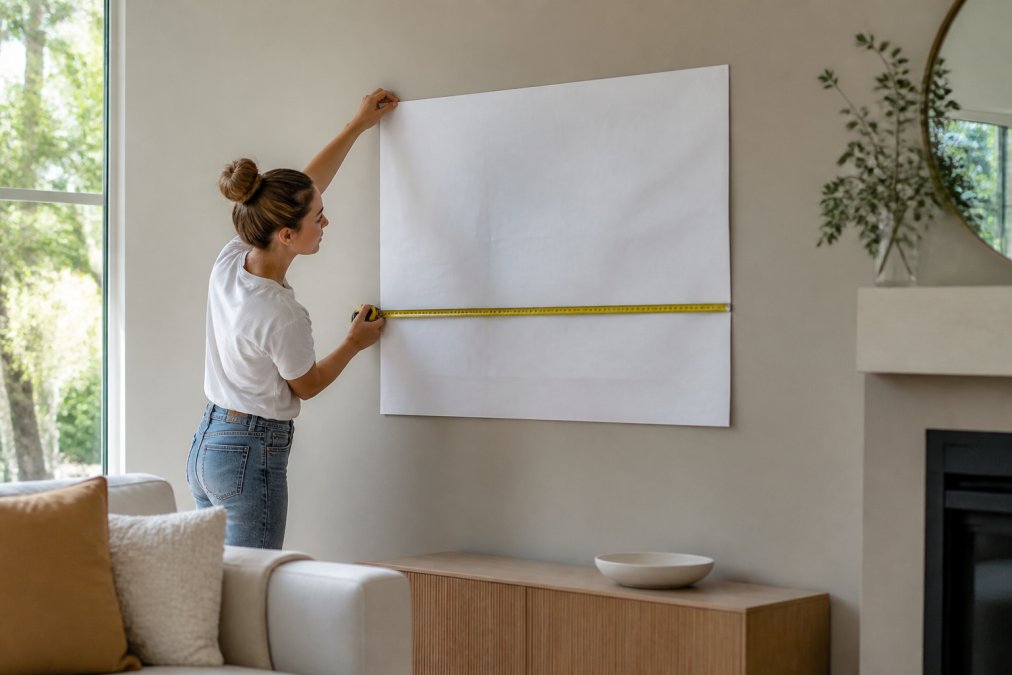
Start with precise measurements of wall width, height, and distance from adjacent features, doorways, windows, and light switches. Create a paper template the exact size of the canvas you're considering. Tape it to the wall at the proposed hanging height and step back. Look from different angles. Sit on your sofa and observe it. Walk past it and note how it affects visual flow. This simple step prevents costly mistakes.
Common mistakes to avoid
The most frequent mistake is buying based on online images without considering actual room dimensions. Measure first, visualise second, buy third. Another common error is hanging oversized art without proper mounting hardware. Using standard picture hooks is a safety risk. People also underestimate the importance of lighting. A beautiful landscape canvas in poor light becomes a disappointment. Finally, many buyers don't consider how the canvas relates to furniture and architectural features. A large landscape piece above a small side table looks awkward; above a substantial sofa it looks intentional.
| Consideration | Action | Outcome |
|---|---|---|
| Wall dimensions | Measure width, height, and adjacent features | Accurate sizing prevents oversizing |
| Canvas proportion | Create paper template and test placement | Visual confirmation before purchase |
| Mounting hardware | Use studs and hardware rated for weight | Safe, secure installation |
| Lighting conditions | Assess existing light and plan accent lighting if needed | Canvas displays properly and colours appear true |
| Furniture relationship | Position canvas relative to substantial furniture pieces | Balanced composition that anchors the space |
| Colour intensity | Visualise saturated colours at full scale | Realistic expectation of visual impact |
Oversized landscape art can transform a room when chosen and installed correctly. Problems arise when scale is misjudged, installation is rushed, or the canvas isn't suited to the space. By measuring carefully, visualising before purchasing, and investing in proper installation and lighting, you can hang a large landscape canvas that anchors your room rather than overwhelming it.
At paints2prints, we understand that choosing the right size landscape art is personal and specific to your space. Our customisable sizes and framed or unframed options let you tailor your purchase to your exact dimensions. We also provide free shipping to the UK and EU, so you can order with confidence knowing your canvas arrives safely and ready to hang. Start by measuring your space, then explore our collection to find the landscape art that works for your home.
Frequently Asked Questions
How do I know if modern landscape art is too big for my wall?
Oversized landscape art typically becomes problematic when it covers more than 75% of your wall space or leaves less than 15cm of negative space on either side. The centre of the artwork should sit at approximately 145cm from the floor to align with average eye level. If the piece overwhelms your furniture or makes the room feel cramped rather than anchored, it's too large. Test by taping paper templates to your wall before purchasing, this prevents costly mistakes.
What is the art to wall ratio rules for hanging landscape prints?
The standard art to wall ratio follows the 50-75% wall coverage rule: your artwork should occupy between half and three-quarters of your wall's visual space. For a feature wall, aim for 60-70% coverage. This ensures the piece becomes a focal point without creating visual clutter. Larger rooms with high ceilings can accommodate art closer to 75%, whilst smaller spaces perform better at 50-60%. Balance is key, too small and the art disappears; too large and it dominates uncomfortably.
Does oversized landscape art make a small room look smaller?
Oversized landscape art can make a small room feel cramped if it's disproportionate to wall dimensions, but when properly scaled, it actually creates the opposite effect. Large-scale pieces with open composition and calm colour palettes (typical of landscape art) can enhance spatial harmony and draw the eye outward, making rooms feel more expansive. The key is respecting the 50-75% wall coverage rule and ensuring adequate negative space around the piece. Poor placement and excessive colour saturation are what create visual clutter in compact spaces.
What structural issues arise with very large canvas paintings?
Large canvas pieces require proper mounting hardware rated for their weight, canvas tension increases significantly with size, and inadequate support risks sagging or wall damage. Oversized framed art demands sturdy wall anchors suitable for plasterboard or masonry. Canvas itself can develop wrinkles or distortion if not properly stretched during manufacturing. Additionally, transport and installation become logistically complex, increasing damage risk. Before purchasing, verify your walls can support the weight and consult installation guides specific to your wall type.
This article was written using GrandRanker
0 commentaire