

Table of Contents
- Understand the Two-Thirds Rule for Wall Art
- Measure Your Wall Space for Art
- Calculate Canvas Dimensions Using Furniture Width
- Standard Canvas Sizes Available in the UK
- How to Arrange Multiple Canvas Prints
- Position Your Canvas Art at Eye Level
- Choose Canvas Size by Room Type
- Conclusion
Last Updated: August 6, 2026
Understand the Two-Thirds Rule for Wall Art
The two-thirds rule is a fundamental principle in interior design that dictates how much of your wall space should be occupied by art. This guideline suggests that your canvas art size should cover approximately two-thirds of the wall area above a piece of furniture, creating visual balance and preventing your artwork from appearing either lost or overwhelming.
When you apply this principle correctly, your room feels intentional and curated rather than haphazard. The rule works because it creates a visual anchor point that draws the eye without dominating the entire wall. Too small, and your art becomes an afterthought. Too large, and it creates an uncomfortable sense of scale that makes the room feel cramped.
The beauty of this approach is its simplicity. If your wall space is 1.5 metres wide, aim for canvas art that occupies roughly one metre of that width. This mathematical precision removes the guesswork from selecting the right dimensions. Many homeowners find this rule transforms their decorating process from anxiety-inducing to straightforward.
However, the two-thirds rule isn't absolute. Room proportions, ceiling height, and furniture arrangement all influence whether you should stick strictly to this guideline or adjust it slightly. Understanding when to apply it rigidly and when to bend it is what separates amateur decorating from professional-looking results.
Measure Your Wall Space for Art
Accurate measurement is the foundation of choosing canvas art size correctly. Before you select any artwork, you need precise dimensions of your wall and the furniture it will hang above.
Start by measuring the width of the wall section where you plan to hang your canvas. Use a tape measure and note the distance from one edge to the other. Then measure the height of the wall from the floor to the ceiling, or from the floor to any architectural features that might influence your decision. Don't estimate, measure twice and record everything.
Next, measure the width of the furniture piece beneath where you'll hang your art. Whether it's a sofa, bed, desk, or console table, this measurement is critical. Your canvas art size should relate directly to the furniture width, not the entire wall. This relationship creates visual harmony and prevents your artwork from appearing disconnected from the room's layout.
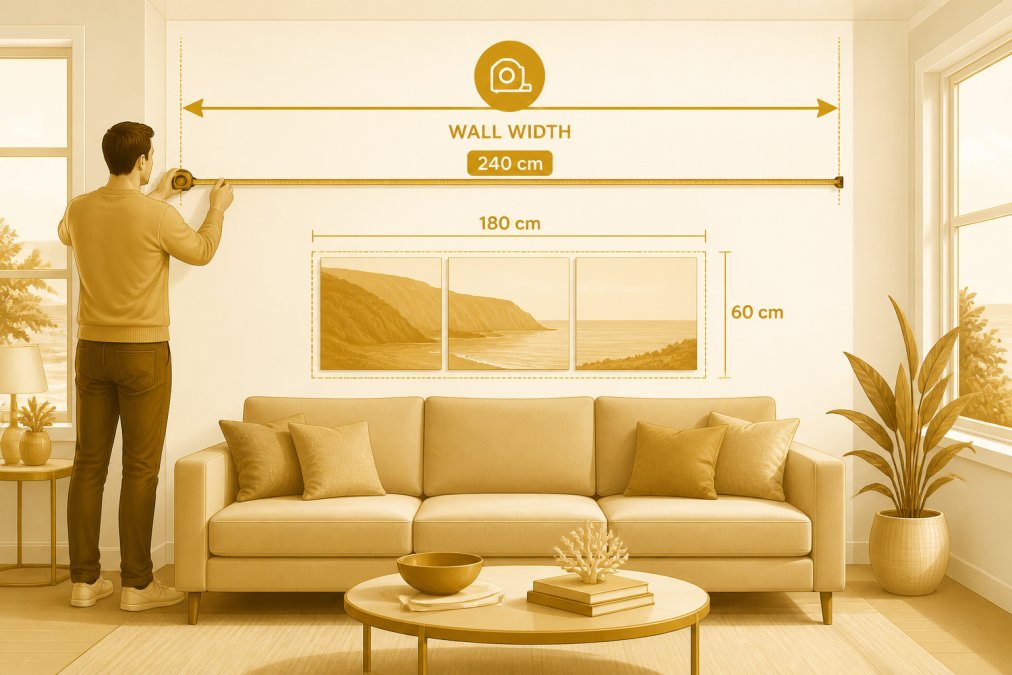
Record all measurements in centimetres for consistency. Take photos of your wall and furniture from different angles, these visual references help when you're browsing canvas options online. Many people make the mistake of relying on memory alone, which leads to ordering artwork that doesn't fit their space properly.
When measuring, account for any wall features that might affect placement: light switches, outlets, windows, or architectural trim. These elements influence not just where you can hang your canvas, but also how large it should be to maintain visual balance around them. A canvas that works perfectly on a blank wall might feel awkward next to a window.
Calculate Canvas Dimensions Using Furniture Width
The relationship between your furniture width and canvas art size is where the two-thirds rule becomes practical. Once you know your furniture width, calculating the appropriate canvas dimensions becomes straightforward mathematics.
If your sofa or furniture piece is 1.8 metres wide, multiply that by 0.67 (two-thirds) to get approximately 1.2 metres. This is your target width for the canvas art size you should select. This calculation ensures your artwork complements rather than competes with your furniture.
For single canvas prints, aim to match this calculated width as closely as possible. If your calculation suggests 1.2 metres but standard sizes don't offer that exact dimension, choose the nearest size that doesn't exceed your calculation. Slightly smaller is always better than oversized, which can overwhelm a room and make furniture appear cramped.
The height of your canvas matters equally. Most canvas prints come in standard aspect ratios, landscape (wider than tall), portrait (taller than wide), or square. Your furniture width calculation determines the width; the aspect ratio you choose determines the height. A landscape canvas works well above a wide sofa, while portrait orientation suits narrower wall spaces or vertical walls.
paints2prints offers customizable canvas art sizes, which removes the constraint of standard dimensions. This flexibility means you can calculate your exact ideal canvas art size and have it printed to those precise specifications. Rather than compromising on dimensions to fit standard options, you can order artwork that matches your space perfectly.
Create a simple calculation sheet: furniture width × 0.67 = ideal canvas width. Then decide your preferred aspect ratio and calculate the corresponding height. Write these target dimensions down before you start browsing options.
Standard Canvas Sizes Available in the UK
Understanding standard canvas sizes helps you navigate options quickly, even though custom sizing is increasingly available. Most UK retailers offer canvas prints in predictable dimensions that accommodate common wall spaces and furniture widths.
Common standard canvas sizes in the UK typically range from small (20×25 cm) through to large (100×150 cm and beyond). Medium sizes, around 60×80 cm or 70×100 cm, suit most living rooms and bedrooms. These dimensions work well above furniture pieces that are 1.2 to 1.8 metres wide, which covers the majority of domestic spaces.
Square canvases (60×60 cm, 80×80 cm) offer visual interest and work particularly well in modern or minimalist interiors. Landscape orientations dominate in the UK market, reflecting the popularity of coastal and nature-inspired prints that work naturally in wider formats.
When you're comparing standard canvas sizes, remember that the actual printed image may not fill the entire canvas, some retailers leave a border for mounting and framing. Always check the visible image dimensions, not just the overall canvas size. This distinction matters more than many people realize.
The advantage of standard sizes is availability and faster delivery. However, if your calculated ideal canvas art size falls between standard options, don't compromise on fit just for speed. Custom sizing ensures your artwork looks intentional in your space rather than like you settled for what was available.
How to Arrange Multiple Canvas Prints
Arranging multiple canvas prints requires a different approach than hanging a single large piece. The spacing between canvases, their alignment, and their collective visual weight all influence how professional your gallery wall looks.
The standard spacing recommendation is 5 to 10 centimetres between canvas edges. This gap creates visual separation while maintaining unity across the arrangement. Too little space makes canvases feel crowded; too much makes them appear disconnected.
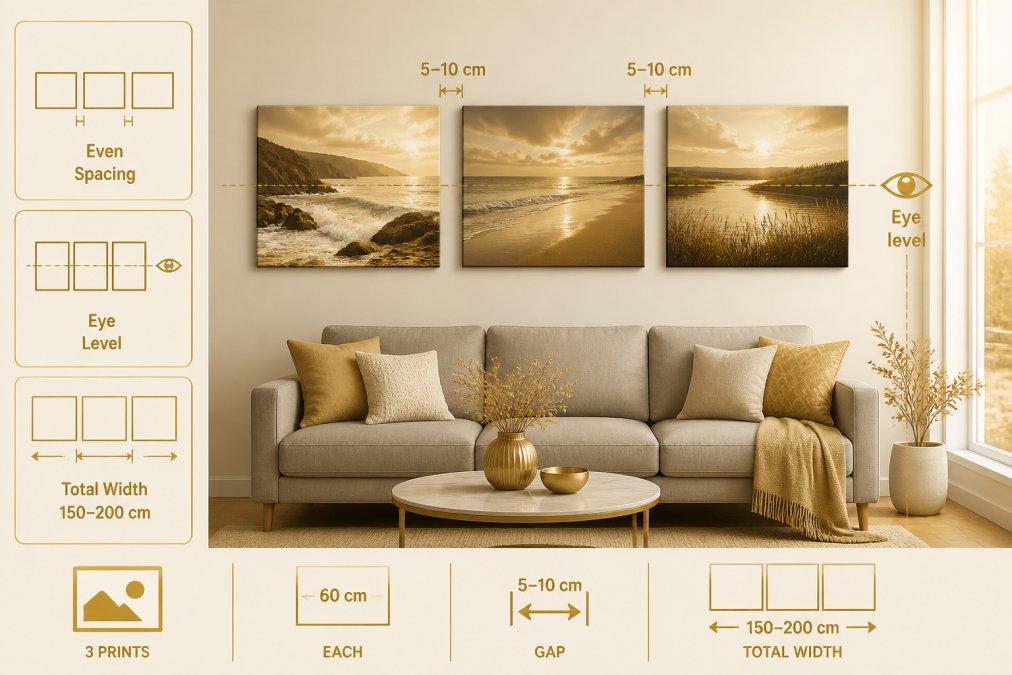
Before you hang anything, create a template on the wall using paper and painter's tape. Trace the outline of each canvas on paper, cut it out, and tape it to your wall in the arrangement you're considering. This allows you to visualize the final result without making nail holes. Step back and assess the balance from different distances and angles.
Alignment matters significantly. A perfectly horizontal line of canvases creates a formal, structured look. Staggered arrangements, where canvases sit at slightly different heights, feel more casual and contemporary. Vertical stacking works in narrow spaces or alongside tall furniture.
The total visual weight of multiple canvases should still follow the two-thirds rule when considered as a unit. If you're hanging three canvases above a sofa, their combined width should approximate two-thirds of the sofa width. This prevents your gallery wall from overwhelming the furniture or appearing too small for the space.
Symmetrical arrangements (matching canvases in matching frames) convey formality and calm. Asymmetrical arrangements (varied sizes, frames, or images) feel more dynamic and personal. Choose based on your room's existing aesthetic and your own preference.
Position Your Canvas Art at Eye Level
Hanging height dramatically affects how viewers interact with your canvas art size and image. The standard recommendation is to position the centre of your artwork at approximately 150 to 160 centimetres from the floor, roughly at average eye level when standing.
This guideline works for most living spaces and creates an instinctive sense of rightness. When art hangs at eye level, viewers naturally engage with it without straining their necks or feeling the artwork is floating awkwardly on the wall.
However, eye level varies depending on context. Above a sofa, you might hang canvas lower (around 120 to 140 centimetres to the centre) because viewers are seated. Above a desk or console table, slightly higher positioning (160 to 180 centimetres) often works better. The key is considering how people will view the artwork in that specific context.
If you're hanging multiple canvases, calculate the centre point of your entire arrangement and position that at eye level. This creates visual cohesion across the gallery wall. Measure carefully from the floor to ensure consistency, use a spirit level to verify that your arrangement is truly horizontal.
Architectural features influence positioning too. If a window, doorway, or built-in shelving sits at an unusual height, you might adjust your canvas art size positioning slightly to relate to those elements rather than strict eye-level rules. The goal is making your artwork feel intentional within the room's architecture, not fighting against it.
Choose Canvas Size by Room Type
Different rooms have different proportions, lighting conditions, and viewing distances that influence which canvas art size works best. Tailoring your choice to the specific room creates a more harmonious result.
Living Rooms
Living rooms typically feature the largest furniture pieces and the most viewing distance, making them ideal for substantial canvas art. A sofa that's 2 metres wide can support a canvas of 1.3 to 1.5 metres in width. The distance people sit from the wall, usually 2 to 3 metres, means larger artwork reads well and creates visual impact.
Coastal and landscape prints work particularly well in living rooms, where they serve as conversation pieces and focal points. paints2prints's collection of nature-inspired prints suits this space perfectly, offering the kind of imagery that invites relaxation and contemplation.
Bedrooms
Bedrooms require more restraint with canvas art size. These intimate spaces benefit from artwork that feels personal rather than commanding. A bed that's 1.4 metres wide suits a canvas of roughly 90 to 100 centimetres. Bedroom viewing distance is typically closer than living rooms, so slightly smaller artwork prevents the space from feeling oppressive.
Calming imagery matters in bedrooms. Soft landscape prints, gentle coastal scenes, or nature-inspired designs create a peaceful environment that supports rest and relaxation.
Hallways
Hallways present unique challenges because they're narrow and people view artwork while moving through them. Canvas art size in hallways should be moderate, typically 50 to 80 centimetres wide. Vertical or portrait-oriented canvases work better than landscape in these spaces, as they fit the proportions of most hallway walls.
Hallway artwork doesn't need to be massive to make an impact. A well-chosen piece with strong visual interest commands attention even in a compact format.
Kitchens and Dining Areas
These functional spaces benefit from canvas art that complements rather than dominates. Kitchen walls are often interrupted by cabinets, windows, and appliances, limiting suitable wall space. Canvas art size should be modest, typically 40 to 70 centimetres, and positioned where it won't interfere with cooking or dining activities.
Nature-inspired and coastal prints work well in these spaces, creating a sense of calm in areas that can feel busy and utilitarian.
Choosing canvas art size successfully combines mathematical precision with aesthetic judgment. Start by measuring your space accurately, apply the two-thirds rule to calculate appropriate dimensions, and consider your room's specific characteristics. The effort you invest in getting these fundamentals right transforms your walls from blank surfaces into intentional, professional-looking displays.
At paints2prints, we understand that getting the size right is just the beginning. Our customizable canvas options mean you can order artwork in the exact dimensions your space requires, with high-quality printing and the choice between framed or unframed finishes. With free shipping to the UK and EU, transforming your living space with perfectly-sized canvas art has never been more accessible.
Frequently Asked Questions
What is the two-thirds rule for wall art?
The two-thirds rule states that your canvas art should cover approximately two-thirds of the wall space above a piece of furniture, such as a sofa or bed. This creates visual balance and prevents the artwork from appearing too small or too large. For example, if your sofa is 1.8 metres wide, aim for canvas art measuring around 1.2 metres in width. This proportion feels intentional and anchors the room's focal point without overwhelming the space.
How do I choose the right canvas art size for my space?
Start by measuring your wall space and the furniture beneath it. Apply the two-thirds rule: your canvas width should be roughly two-thirds the width of your furniture. Measure from floor to ceiling to ensure the artwork sits comfortably within your room's proportions. Consider the room's scale, a large open living room can handle bigger canvas dimensions, while a small bedroom benefits from smaller, more intimate sizes. Always account for negative space around the artwork for visual breathing room.
What are the most popular canvas art sizes in UK homes?
Common standard canvas sizes in the UK include 60x40 cm, 80x60 cm, 100x75 cm, and 120x80 cm. For gallery walls with multiple prints, many homeowners choose smaller sizes like 40x30 cm or 50x40 cm. Larger statement pieces often measure 150x100 cm or more. The best size depends on your wall dimensions, ceiling height, and the furniture it will hang above. Custom sizes are also available to fit your exact specifications.
How high should I hang canvas art above furniture?
Hang your canvas art 15-25 centimetres above the top of your furniture, with the centre of the artwork positioned at eye level (approximately 1.5 metres from the floor). This spacing creates visual connection between the furniture and the art without making either feel isolated. For gallery walls with multiple prints, maintain consistent spacing between each piece and ensure the overall arrangement remains centred at eye level for the best viewing experience.
This article was written using GrandRanker
0 comments